Utility Warehouse Income: What UW’s Five-Year Plan Means for Partners
Utility Warehouse has set out a major five-year plan, and for anyone looking seriously at the Utility Warehouse income opportunity, it is worth taking a proper look at what has just been announced. Not because any announcement creates success on its own. It doesn’t. Not because income is automatic. It isn’t. And not because a business grows just because a company publishes a strategy document.
The real importance is this: Utility Warehouse is making a significant long-term investment in the very parts of the business that matter most to Partners — the customer proposition, Partner tools, brand awareness, customer service, and the growth of multi-service customers.
For existing Partners, that should feel encouraging. For new people looking at the Utility Warehouse opportunity for the first time, it helps explain why this is very different from a quick, short-term side hustle.
Utility Warehouse is a long-term, essential services business. It helps households save time and money across services such as energy, broadband, mobile and insurance. It is powered by a word-of-mouth Partner model built around personal recommendation, local relationships and consistent activity.
The latest update makes one thing very clear: UW’s next phase is focused on quality, not just quantity. The company wants to grow from around half a million multi-service customers today to more than one million by FY31. That matters because multi-service customers are the customers who typically stay longer, take more services and create greater long-term value. For Partners, that is where the conversation about Utility Warehouse income becomes especially important.
Save | Earn | Refer | Get further info | Ask questions | Or call Jeremy on: 01527 523 013 / 07726 196 153.
Why this announcement matters
There are plenty of ways to earn an extra income in the UK. Some people take on overtime. Some start a small online business. Some deliver parcels, drive, freelance, rent a room, sell products, or take on a second job. There is nothing wrong with any of those options. Many are useful. Many are necessary. But most are directly tied to the hours you personally work.
Utility Warehouse is different because it sits in the essential household services market. People need energy. They need broadband. They use mobile phones. Many need insurance. These are not luxury purchases or passing trends. They are part of normal household life.
That does not make the opportunity easy. It does not remove the need for activity. But it does mean Partners are talking to people about services they already use, already pay for, and often already want to simplify or reduce.
The five-year plan puts renewed focus on that core strength. UW is not simply chasing customer numbers. The company has openly recognised that, in a competitive market, it has taken on more single-service customers than it ideally wants. Customer growth has been strong, but the average number of services per customer has declined. That is the key commercial challenge this plan is designed to address.
More multi-service customers. Better long-term customer value. Stronger customer retention. More support for Partners. A clearer brand. Better digital tools. Better service. That is the backdrop to the announcement.
“Utility Warehouse has always rewarded consistency more than hype. This five-year plan simply gives Partners a stronger platform on which to build. Residual income is not magic money. It is the result of helping real customers, looking after them properly, and staying consistent long enough for momentum to build.” — Jeremy Tromans, Utility Warehouse Partner

The target: one million multi-service customers
The headline target is ambitious: Utility Warehouse aims to more than double its number of high-quality multi-service customers, from around 500,000 today to more than one million by FY31. That is a big statement.
But it also makes sense when you understand the UW model. A single-service customer may join for one reason, such as energy or broadband. A multi-service customer is more deeply connected to the UW proposition. They may have one monthly bill, one account, one app, and greater savings from taking more services. That combination of savings, simplicity and service is the heart of the Utility Warehouse model.
For Partners, multi-service customers matter because the business is not built around one-off transactions alone. The long-term value is in helping people move several essential services to UW, then looking after them properly so they stay. That is where residual income can develop.
Again, it is important to be realistic. Residual income does not appear by magic. It depends on customers, services, retention, activity, consistency, team building and the wider market. But the principle is powerful: work done today can continue to have value in the future when customers remain with UW and continue using their services. That is very different from being paid once and starting from zero again the next day.
“What excites me most is not just the size of the investment, but where it is going — into the customer offer, the Partner network, the brand, and the tools that help ordinary people build something around real life.” — Jeremy Tromans, Utility Warehouse Partner
The scale of the business behind the opportunity
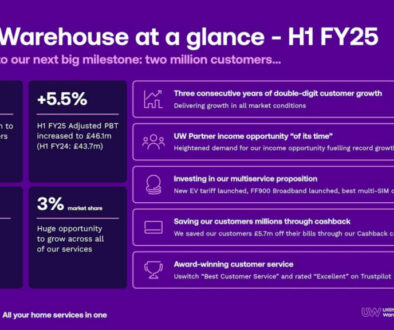
One of the reasons people sometimes underestimate Utility Warehouse is that it has historically been less visible than some of the major household names in energy, broadband or mobile. That is changing. The latest results show a business with around 1.43 million customers, 3.80 million services, 77,200 Partners and revenues approaching £2 billion.
Those figures matter because they put the Partner opportunity into context. This is not a small experimental idea. Utility Warehouse has been operating for almost 30 years. It is listed on the London Stock Exchange through Telecom Plus PLC. It has built a substantial customer base, a national Partner network and a multi-service model that is difficult for conventional providers to copy. At the same time, there is still significant room for growth.
Charles Wigoder, the company’s founder and chairman, made the point powerfully in the Partner update. Even after nearly three decades, UW’s most successful service, energy, still has only a small share of the market.
In plain English, that means the business is already large, but the potential addressable market remains much larger. For people researching Utility Warehouse income, that combination is important. You want to know the company has a track record, but you also want to know there is still a market to build into. UW appears to have both.
The biggest investment in Partners so far
The Partner-facing message around this five-year plan is clear: Utility Warehouse is investing heavily. The company has said the plan will require around £55 million per year of investment across four main areas. Over five years, that adds up to more than £250 million. The four pillars are:
1. Improving the customer offer
This is about making the customer proposition easier to recommend. That matters enormously. A Partner can be enthusiastic, well trained and committed, but the customer offer still has to make sense. People need a reason to listen. They need a reason to compare. They need a reason to switch. UW has already made several changes through recent Partner events such as Amplify and Power Up, including improved mobile offers, broadband promotions, fixed energy tariffs and Cashback Card incentives for certain multi-service customers.
The direction is clear: make the offer more referable. That word “referable” is important. In a Partner-led business, the proposition has to be simple enough to explain, strong enough to recommend, and valuable enough for people to feel comfortable sharing with friends, family, neighbours, colleagues and local contacts.
2. Investing in Partners
The second pillar is direct investment in Partners. This includes tools, technology, AI, the Partner app, marketing support, in-app quoting, AskMii, and the development of different ways to earn.
Justin Bozzino highlighted Connectors as one example. The Connector programme gives more people a simple way to refer others to UW, even if they are not ready to build a full Partner business. That matters because not everyone wants to start in the same way. Some people want to build a team. Some want to gather customers. Some want to refer occasionally. Some want to test the water first. Some are connected to community groups, clubs, charities, local organisations or sports teams.
A broader range of earning routes gives more people a way in. It also gives active Partners more conversations to have.
3. Building the brand
Utility Warehouse has often been described as one of the UK’s best kept secrets. That can be a strength and a weakness. It is a strength because many customers and Partners have grown the business through genuine recommendation rather than heavy advertising. But it can also be a weakness if people have not heard of UW, or do not immediately understand what it does.
The new plan includes investment in brand awareness, with a focus on becoming more recognised and trusted. For Partners, this could be a major benefit.
A stronger brand does not replace activity. It does not do the work for you. But it can make conversations easier. When someone has already seen the brand, heard the name, or understands that UW brings multiple household services together, the Partner is not starting from a blank page.
The new brand identity around “people helping people” also fits the Partner model well. Utility Warehouse is not just another comparison site. It is not just another app. It is a local, human, recommendation-led route to household savings and additional income. That human element is one of the reasons many people are attracted to it.
4. Improving customer service and digital experience
Customer service is not a side issue in this business. It is central. Partners recommend UW to people they know. That means service matters personally. If a customer has a poor experience, it reflects not only on the company but also on the Partner who recommended it.
That is why investment in customer service, digital tools, WhatsApp support, AI-assisted service and more efficient customer journeys is so important. The easier it is for customers to join, manage their account, get help and stay happy, the stronger the proposition becomes. It also gives Partners more confidence.
Most Partners do not want to “sell” something and disappear. They want to know their customers will be looked after. They want to feel proud of what they recommend. Strong customer service supports that confidence.

What this means for Utility Warehouse income
The phrase “Utility Warehouse income” can mean different things depending on where someone is in their journey. For a new person, it might mean earning a few hundred pounds by helping friends or family save money. For a part-time Partner, it might mean creating a regular second income alongside a job, business, family or retirement.
For someone building a team, it may mean developing a longer-term residual income from customers and Partners introduced over time. For an experienced Partner, it can mean a serious, structured, long-term business.
What makes UW interesting is that the income opportunity is linked to essential services rather than a fashionable product, stock purchase, monthly subscription box or one-off sale.
Customers use the services every month. Partners can be paid based on the services used by customers they have introduced. Over time, with enough consistency, that can build into something meaningful. But there is a very important point here. The income is not guaranteed. It is not automatic. It requires conversations, follow-up, learning, resilience, customer care and consistent action.
Some people will do very little and earn very little. Others will develop the skills, habits and team culture needed to build something more substantial. That is true of most worthwhile things. The five-year plan does not remove the need for effort. It strengthens the environment in which that effort takes place.
Why multi-service customers are so important
The whole announcement comes back to one central theme: multi-service customers. A multi-service customer is not just someone who has chosen UW for one bill. They have decided to trust the company with more of their household services. That normally means they are more connected to the proposition. They may be saving across more areas. They may be using the app more often. They may value the simplicity of one monthly bill. They may be more likely to stay because UW is doing more for them.
This is why the company is putting such focus on growing multi-service customer numbers. For Partners, this is a reminder of something very practical. The best UW conversations are rarely just about one cheap tariff. They are about the household as a whole. Energy. Broadband. Mobile. Insurance. Cashback. Simplicity. Service. A single account. A local person to help explain it. That is where the real value of the model becomes clearer.
The role of consistency
One of the strongest themes in the Partner update was not just investment. It was activity. Charles Wigoder used the phrase “meet me halfway”. That is a powerful way to put it. The company can invest in the proposition. It can invest in tools. It can invest in brand. It can invest in customer service. It can create offers, systems, training and technology. But Partners still have to speak to people.
That has always been the heartbeat of Utility Warehouse. A Partner business does not grow because someone watches a video, attends an event or likes the idea. It grows when a Partner develops consistent habits. That may mean making a list. Booking appointments. Following up. Inviting people to information calls. Sharing the customer savings story. Helping people compare their bills. Supporting new Partners. Attending events. Staying plugged in. Getting better at simple conversations.
None of that is complicated. But it does require consistency. In my experience, that is where many people underestimate the opportunity. They either overcomplicate it or underwork it. The people who tend to do well are often not the loudest, flashiest or most naturally confident. They are the people who keep going. They learn the basics. They stay close to the system. They build trust. They do the small things repeatedly. That is not glamorous, but it is powerful.
Mindset, standards and association
A business like Utility Warehouse can change how you think. That may sound like a big statement, but it is true. When you build something part-time, especially around an existing job or family life, you have to become more intentional. You start thinking about time differently. You become more aware of who you spend time with. You start looking at habits, confidence, communication and personal standards.
That is one of the hidden benefits of the UW Partner opportunity. Yes, the income matters. Of course it does. But the personal development matters too. You learn to have better conversations. You learn to handle no. You learn to follow up without being pushy. You learn to present information clearly. You learn to lead by example. You learn that consistency beats occasional bursts of enthusiasm.
You also learn the importance of association. Being around people who are active, positive, practical and forward-looking can make a huge difference. That does not mean blind positivity. It means being in an environment where people are trying to improve their finances, help others, and build something around real life. Jobs. Families. School runs. Caring responsibilities. Health challenges. Busy weeks. Tired evenings. The business has to fit around real life, because that is where most Partners are building it.
A long-term business, not a quick fix
One of the most important points from Charles Wigoder’s message was the inter-generational nature of the business. Utility Warehouse has Partners who are still earning from customers and teams built many years ago. That does not mean everyone will achieve the same result. It does show the long-term design of the model.
This is not a “do it for 30 days and get rich” idea. It is a long-term customer and Partner business. That is why the concept of residual income matters. The most valuable income is often not the quick payment. It is the income that can continue because a customer remains happy, keeps using services, and the Partner continues building properly.
For some people, that can create more flexibility. For others, it can provide a second income. For some, it can become part of a bigger retirement or family freedom plan. But the time horizon matters. If someone is only looking for instant money with no learning curve and no activity, this is probably not the right fit. If someone is prepared to build steadily, develop personally and help households with services they already use, it becomes far more interesting.
Why this is well positioned for new Partners
If you are new to Utility Warehouse, it is easy to wonder whether you have missed the boat. The answer, in my view, is no. A business that has been around for nearly 30 years may sound mature, but the market opportunity remains significant.
Most UK households are not yet UW customers. Most people still pay separate companies for energy, broadband, mobile and insurance. Many are still looking for ways to save money and simplify their bills.
At the same time, more people are looking for ways to earn additional income. The cost of living has changed the conversation. Retirement planning has changed. Job security has changed. Flexible work has changed. The idea of having more than one income stream is no longer unusual.
UW sits right in the middle of those trends. It helps customers look at essential household bills, and it gives Partners a way to earn by helping people they know. The five-year plan strengthens the case because the company is actively investing in the areas a new Partner needs: a stronger offer, better tools, more brand awareness, improved digital support and clearer ways to get started.
Why this matters for existing Partners
For existing Partners, this announcement should feel like a reminder and a challenge. The reminder is that the company is still investing in the Partner model. UW clearly sees Partners as central to its future growth. The challenge is that investment only matters if Partners respond with activity.
If the company improves the offer, but Partners do not share it, nothing happens. If the tools get better, but Partners do not use them, nothing happens. If brand awareness increases, but Partners do not follow up conversations, nothing happens.
This is where “meet me halfway” becomes more than a phrase. It is a practical instruction. Get active. Reconnect with customers. Speak to new people. Use the tools. Invite people to look. Build your list. Follow up properly. Help new Partners start well. Attend events. Raise your personal standard. Momentum is rarely built by one dramatic action. It is built by the small repeatable actions most people could do, but many do not do consistently.
Practical takeaways from Stuart, Justin and Charles
The Partner update gave several clear messages. Here are the practical takeaways I would draw from it.
1. Focus on multi-service customers
The strongest UW customer is usually not the person taking one isolated service. The real value is in helping households understand the combined benefit of several services. That means Partners should become confident explaining the full UW proposition, not just one offer.
2. Use the improved tools
UW is investing in digital tools, AI support, app-based quoting and Partner systems. These tools are designed to make the business easier to explain and easier to duplicate. A tool only helps if it is used.
3. Take the Connector opportunity seriously
Connectors give more people a simple way to refer. For Partners, this can open up new conversations with local groups, community contacts and people who like the idea of recommending UW without necessarily building a full Partner business from day one.
4. Expect brand awareness to help, not replace, activity
A stronger UW brand should make conversations easier over time. But it will not replace personal recommendation. The Partner still matters.
5. Build for years, not weeks
The most powerful part of the UW model is the long-term nature of customer relationships and residual income potential. That requires patience, consistency and a proper business mindset.
6. Keep the customer at the centre
The business works best when customers genuinely benefit. Savings, simplicity and service are not just marketing words. They are the reason people stay.
7. Meet the investment with action
The company is making a major investment. Partners now have to decide whether they will match that with increased personal activity.
A balanced view: what this announcement does not mean
It is also worth being clear about what this announcement does not mean. It does not mean every Partner will build a large income. It does not mean customers will appear without conversations. It does not mean there will be no competition. It does not mean the market will always be easy. It does not mean passive income is instant or effortless.
In fact, the reason this plan exists is partly because the market has become more competitive. UW has seen pressure in areas such as energy and broadband, and the company wants to increase the proportion of customers taking multiple services.
That is not a weakness in the announcement. It is one of the reasons the announcement is credible. Good businesses adjust. They invest. They respond to the market. They focus on the customers that create the strongest long-term value. That is what UW is doing here.
My view as a Utility Warehouse Partner
From my perspective, the most encouraging part of this announcement is not just the size of the investment. It is the direction of the investment. UW is not moving away from Partners. It is investing into Partners. It is not moving away from the multi-service model. It is doubling down on it. It is not pretending the market is easy. It is recognising the challenge and putting serious money behind the solution.
That should give both new and existing Partners confidence, provided that confidence leads to action. I have always believed the Utility Warehouse opportunity rewards people who are prepared to be consistent, coachable and customer-focused.
This update reinforces that belief. There is a big difference between chasing quick money and building long-term income. Utility Warehouse has always been more about the second one.
“This is not about quick wins or empty promises. It is about essential household services, long-term customers, and the kind of steady business growth that can make a genuine difference over time.” — Jeremy Tromans, Utility Warehouse Partner
2026 Five Year Plan - FAQ's

Is Utility Warehouse income worth exploring?
If you are looking for a way to earn additional income in the UK, Utility Warehouse is worth exploring properly. Not casually. Properly. Look at the company. Understand the services. Understand how Partners are paid. Understand the work involved. Speak to someone experienced. Ask sensible questions. Think about who you know. Consider whether you are willing to learn and take consistent action.
The opportunity will not suit everyone. But for the right person, it can be a very practical way to build income around real life. You do not need to be a salesperson in the old-fashioned sense. You do not need to be loud. You do not need to be pushy.
You do need to be willing to talk to people, follow a system, develop your confidence and keep going. That is where the five-year plan becomes exciting. A strong company. A clearer proposition. More investment. Better tools. A growing brand. A renewed focus on high-quality multi-service customers. And a Partner model built around people helping people. For anyone serious about Utility Warehouse income, this is a moment worth paying attention to.
Conclusion: the opportunity is real, but so is the responsibility
Utility Warehouse has set out an ambitious five-year plan to grow multi-service customers, strengthen the Partner channel, improve the customer offer, build brand awareness and invest in digital service. That is good news for Partners. But the most important message is also the simplest.
The company can create the conditions. Partners have to create the activity. That has always been true. The future of Utility Warehouse income will not be built by people sitting on the sidelines. It will be built by Partners who speak to people, help customers, develop teams, use the tools, attend events, raise their standards and keep going long enough for momentum to build.
For me, that is the real message behind this announcement. The opportunity is there. The investment is there. The market is there. Now it comes down to whether we are prepared to meet it with consistent action.
“The company is making its commitment clear. Now the opportunity is for Partners to meet that commitment with activity, standards, belief and consistent action.” — Jeremy Tromans, Utility Warehouse Partner
Save | Earn | Refer | Get further info | Ask questions | Or call Jeremy on: 01527 523 013 / 07726 196 153.